中文
News 

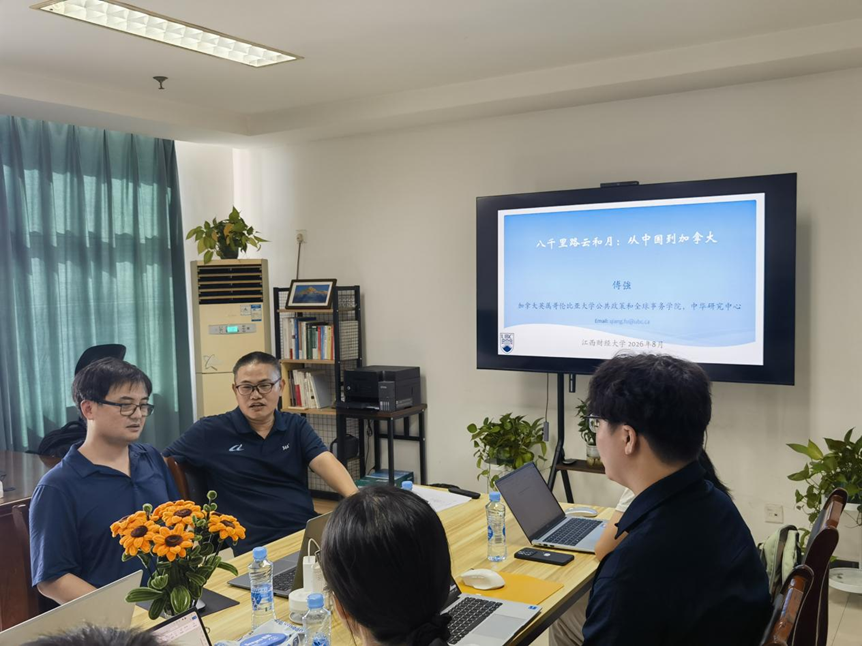
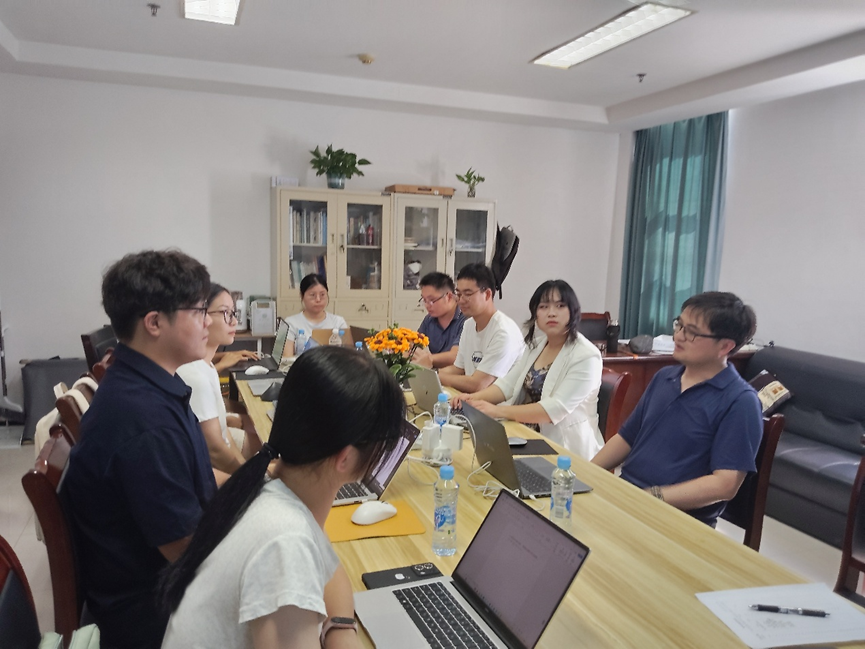
At 3:00 p.m. on August 19, 2026, a lecture in the “Global Competence Workshop” series, organized by the JUFE School of Sociology and Humanities, was held in Room 908 of the Library and Information Building on the Mailu Campus. The workshop featured a special guest lecture by Professor Fu Qiang, an endowed professor at the School of Public Policy and the School of Global Affairs at the University of British Columbia (UBC), Canada, titled “Beyond Chinatown: The Social Construction of Canadian Education—Immigration and the Survival Narratives of Chinese Canadians.” The lecture was moderated by Professor Liang Bo from the Research Center for County-Level Surveys and Socio-Economic Sociology. Young faculty members, including Dr. He Jiaolong, Dr. Zheng Pianpian, and Dr. Ying Kui, as well as numerous undergraduates, masters, and doctoral students, participated in the lecture and subsequent discussion.
Drawing on his interdisciplinary expertise in demography, sociology, and computational social science, as well as his recent qualitative field research in Chinese communities, Professor Fu explored how Canada’s education system and immigration policies collectively shape the survival strategies and social embeddedness of the Chinese community from multiple dimensions, including institutional change, interactive networks, and historical narratives. Faculty and students engaged in an in-depth discussion with Professor Fu on topics such as the identity of Chinese immigrants, intergenerational mobility, and cross-cultural adaptation. During the lecture, drawing on in-depth interviews and field observations conducted across multiple provinces, Professor Fu presented several vivid individual narratives. He also shared detailed insights gained during his fieldwork on how Chinese Canadians actively construct their social positions within the interplay of the education system, the labor market, community interactions, and state institutions. Within the interconnected framework of “education and immigration,” he examined how Canada’s federal and provincial immigration policies, public education system, and professional certification frameworks—collectively forming a set of socially constructed mechanisms—influence Chinese families’ educational decisions, career paths, and inter-generational mobility. Building on this, Professor Fu further emphasized that Chinese sociologists should strive to carry forward the intellectual traditions of academic predecessors such as Wu Wenzao, Pan Guangdan, and Fei Xiaotong; discover and redefine social facts within the Chinese context; reconstruct the epistemological foundations regarding the economy, family, ethics, and social order; and provide insightful explanations for China’s social transformation and change. During the Q&A session, faculty and students in attendance engaged in further in-depth discussions with Professor Fu on relevant research topics. The lecture concluded successfully amid a lively academic atmosphere.
This lecture was part of the “Global Competence Workshop” series at JUFE. It not only deepened faculty and students’ cross-cultural understanding of the “education-migration” nexus but also inspired an academic awareness of examining global society from a Chinese perspective. Professor Fu’s research paradigm and field-based insights provided a vivid example for cultivating well-rounded professionals who combine local concerns with an international perspective, and effectively advanced the school’s academic dialogue and capacity building in the context of globalization.
(Translator: Hong Lumin, Huang Rong, Yao Keyan Reviewer: Jiang Guohe)
Address:West Yu Ping Street, Changbei, Nanchang, Jiangxi Province, P.R.China Post code: 330013
Copyright © School of Sociology and Humanities All Rights Reserved