中文
中文
News 


Recently, Dr. Ying Kui, a faculty member of JUFE the School of Sociology and Humanities and the Green Development and Chinese Modernization Research Center, published a paper as the first author in the prestigious geography journal—Journal of Geographical Sciences, which is designated as a Class A journal by JUFE, in Issue 5, 2026. The paper is titled Characteristics and driving factors of population age structure in China: A study based on the scale nesting theory.
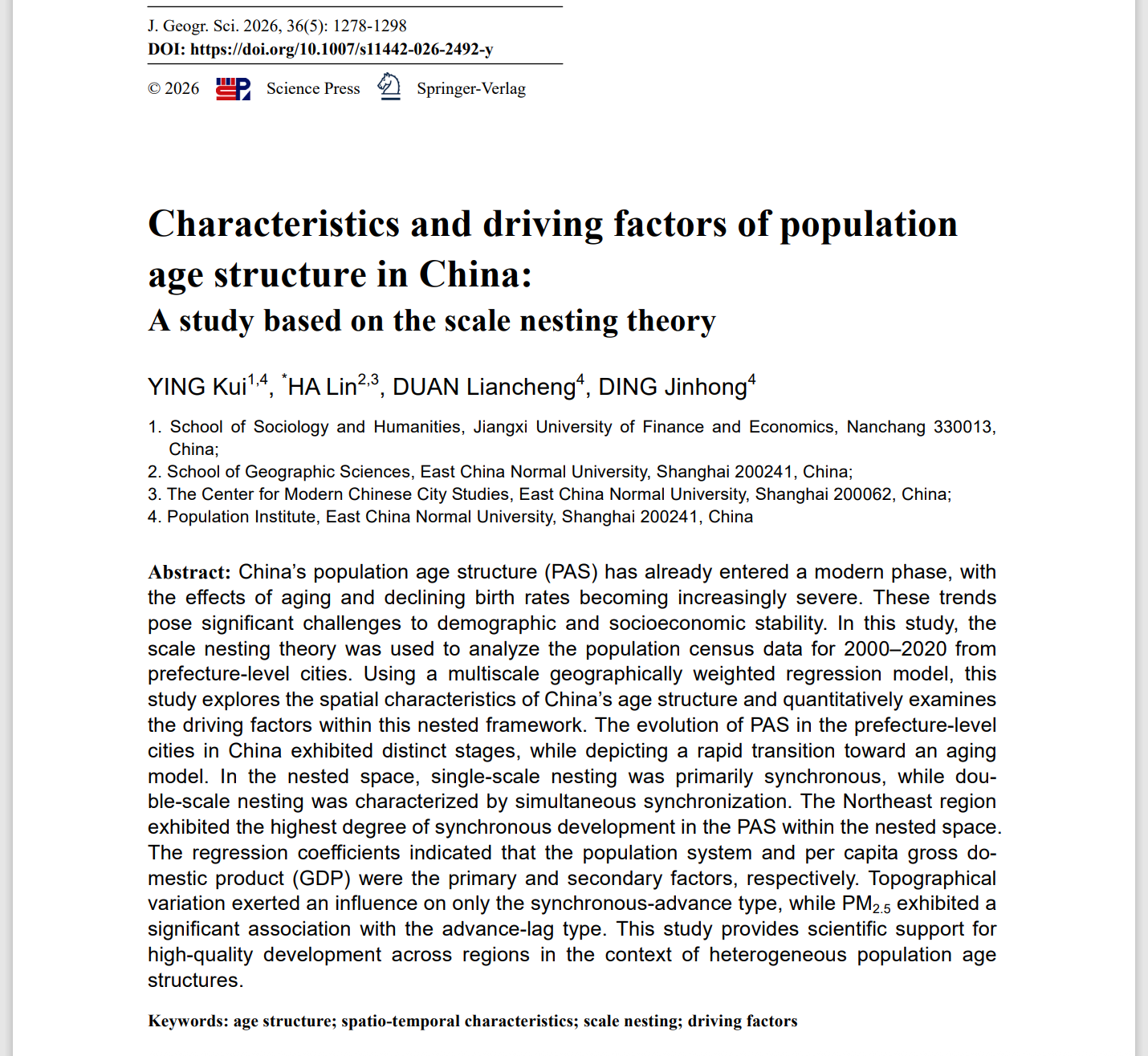
The paper integrates geographical scale theory with ecological nesting theory to propose the scale nesting theory applicable to population geography research, and uses it to reveal the spatial heterogeneity characteristics and driving factors of China's population age structure.
The main findings are as follows: the evolution of PAS in the prefecture-level cities in China exhibited distinct stages, while depicting a rapid transition toward an aging model. In the nested space, single-scale nesting was primarily synchronous, while double-scale nesting was characterized by simultaneous synchronization. The Northeast region exhibited the highest degree of synchronous development in the PAS within the nested space. The regression coefficients indicated that the population system and per capita gross domestic product (GDP) were the primary and secondary factors, respectively. Topographical variation exerted an influence on only the synchronous-advance type, while PM2.5 exhibited a significant association with the advance-lag type. This study provides scientific support for high-quality development across regions in the context of heterogeneous population age structures.
Journal Introduction
Journal of Geographical Sciences is a basic-science English-language academic journal jointly sponsored by the Geographical Society of China and the Institute of Geographic Sciences and Natural Resources Research, Chinese Academy of Sciences. It is recognized as one of the leading journals in the field of geography. The journal is dedicated to promoting academic exchange in geography, with a primary focus on introducing research from both China and abroad on the application of remote sensing, geographic information systems, and other technologies in geographical studies.
Author Introduction

Dr. Ying Kui, male, native of Jingzhou, Hubei Province, holds a Ph.D. in Law. He graduated from the Institute of Population Research, School of Social Development, East China Normal University, under the supervision of Professor Ding Jinhong. Recruited in 2025 as a doctoral talent, he is currently a lecturer at JUFE School of Sociology and Humanities, and serves as a member of the Geriatric Social Work Professional Committee. His main research areas include spatial sociology, aging population studies, and population geography. In the past five years, he has published over 10 papers as first author in journals such as the Journal of Geographical Sciences, Resources and Environment in the Yangtze Basin, and World Regional Studies.
(Translator: Hong Lumin, School of Sociology and Humanities Reviewer: Jiang Guohe)
Address:West Yu Ping Street, Changbei, Nanchang, Jiangxi Province, P.R.China Post code: 330013
Copyright © School of Sociology and Humanities All Rights Reserved