
On September 18th, the School of Humanities and the Research Department of the University invited Professor Yang Dian of the School of Social and Ethnic Studies of the Chinese Academy of Social Sciences (CASS) to give an online lecture on the theme of “The Art of Publishing: Awareness of Problems, Selection of Journals, and Publication of Papers”. Prof. Yang Dian is a doctor of sociology from Harvard University, deputy director and researcher of the Institute of Sociology, Chinese Academy of Social Sciences, deputy editor-in-chief of Sociological Research, executive deputy editor of The Journal of Chinese Sociology, and executive deputy secretary-general of the Chinese Sociological Association. The lecture was hosted by Prof. Jiang Guohe, Dean of the School of Humanities, Jiangxi University of Finance and Economics, and was attended by more than 300 people, including teachers and students of the School of Humanities.
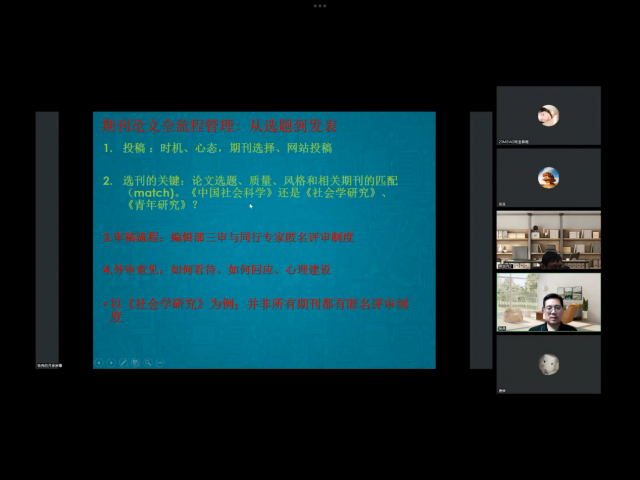
Before the beginning of the lecture, Prof. Jiang Guohe introduced Prof. Yang Dian to the participants, expressed his sincere thanks and warm welcome to Prof. Yang for taking time out of his busy schedule to give online lectures for our students and teachers, and pointed out that Prof. Yang’s topic “The Art of Publication: Problem Awareness, Journal Selection and Publication” is a very good topic, which will be very beneficial to our teachers, including our graduate students, in how to improve problem awareness, writing ability and how to select journals for publication. He also pointed out that Prof. Yang’s topic “The Art of Publication: Problem Awareness, Journal Selection and Publication”is a very good topic, which will be very beneficial to our teachers, including our graduate students, in how to improve the problem awareness and writing ability in selecting and writing thesis topics, as well as how to select journals for publication.
At the beginning of the lecture, Prof. Yang Dian pointed out that there are a lot of links in the process of managing the whole process from topic selection to publication of journal papers, and these links have certain patterns and certain rules. The most important one is the strategic issue of topic selection, while the others are tactical issues, and the topic selection itself will affect the tendency and focus of the journal. In the process of selecting topics, we should be innovative, have a sense of problem, and choose carefully according to our own interests and the theory and importance of the issue itself. According to Prof. Yang Dian, publication is an art: both scientific and artistic, a systematic project, which needs to pay great attention to each link and require continuous learning, training and improvement. At the same time, Prof. Yang also pointed out the efforts we have to make before, during and after the submission of a high-quality paper. Prof. Yang pointed out that the essence of a journal is to construct rather than to filter, and a journal paper is also a process of social construction. Submission is only a half-finished product, and it may end up being completely different from submission to publication, and there is no overnight publication, so we are encouraged to learn more from the teachers who have already published articles in the target journals, and to study the articles in the target journals meticulously. Finally, Prof. Yang Dian explained the innovations and challenges facing Chinese sociology under the new media and new perspectives in the context of the new era, and put forward the importance of interdisciplinary research and practice, as well as how to continuously deduce and improve theories in practice.

At the end of the lecture, Prof. Yang Dian patiently answered the questions raised by our teachers and students, which brought a lot of inspiring thoughts to everyone. Before the end of the lecture, the moderator, Prof. Jiang Guohe, thanked Prof. Yang Dian again for the wonderful lecture and made a concluding speech, saying that he hoped everyone could actively participate in similar activities and have more academic exchanges, and he hoped that more students could submit their articles in high-level journals such as the Sociological Research to improve their academic ability.
